
Phoenix metro · residential pest control
Don’t just spray the house.Defend the property.
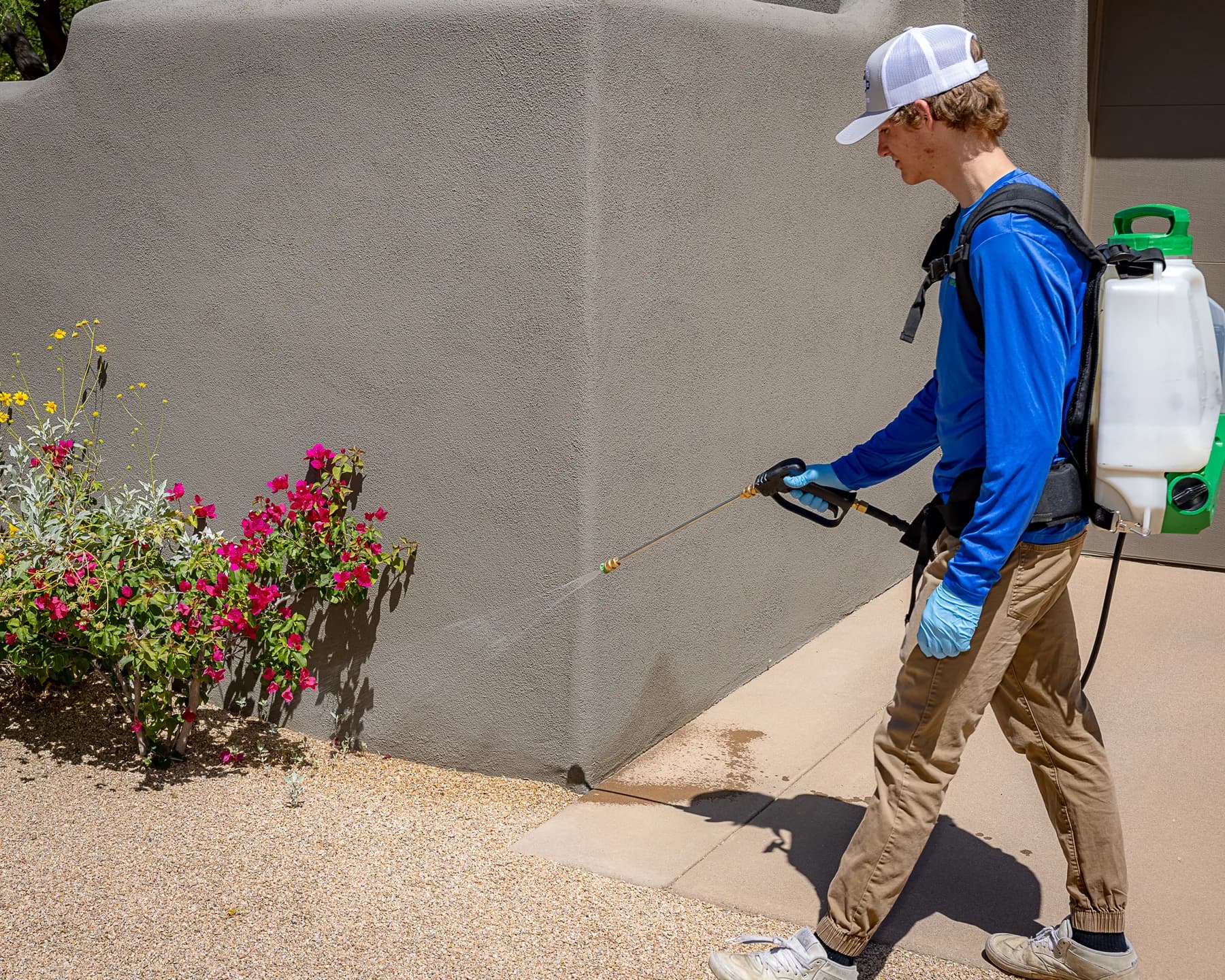
Most pest control treats a perimeter and leaves. The 4D Barrier works four treated zones inward — the block wall, the yard, the home perimeter, the interior — because on a Valley lot the problem is almost never where you saw the pest.
- 4.8 from 95 reviewsOn Google — read them
- Bi-monthly Flagship Special$69 (retail $79) · every 2 months
- Free inspectionWeekday appointments
Free inspection and quote
Tell us what you are seeing and where. The inspection and the quote are both free.
Start here
What did you notice?
Nobody searches for a species. They search for the thing they saw. Pick the closest one.
Most often: Arizona bark scorpion, which shelters outdoors and comes in at night to hunt.
Could also be: A stripe-tailed or giant hairy scorpion — less of a medical concern, same entry routes.
Most often: Subterranean termites building a covered route from soil to wood.
Could also be: An old, abandoned tube from a previous infestation — which still needs looking at.
Most often: American cockroaches coming in from sewer or irrigation lines.
Could also be: A local breeding site in a warm damp spot — different treatment entirely.
Most often: German cockroaches, which breed indoors and need an interior-focused approach.
Could also be: Juvenile American roaches, if the entry route is nearby.
Most often: Roof rats, which travel fence lines, irrigation lines and citrus into attics.
Could also be: Birds nesting in a tile roof or eave, which is a different job.
Most often: Mice or roof rats using the space to feed or nest.
Could also be: Roach frass, which looks similar at a glance and means something different.
Most often: A colony outdoors following a moisture or food route in.
Could also be: More than one colony — trails from different directions usually mean exactly that.
Most often: Bees or wasps establishing in a wall void, eave or shed.
Could also be: A termite swarm, if it is after a monsoon rain and they drop their wings.
Most often: Spiders following the insects already on the property.
Could also be: Black widow, which prefers low, dark, undisturbed places — worth identifying.
This points you at the right reading — it is not an identification. Several of these clues have more than one cause, and the two that matter most financially (termites and German roaches) are the two you least want to guess at. If you are not sure, have someone walk the property — the inspection and the quote are free.
The 4D Barrier Pest Defense System
Four treated zones, worked inward
From the block wall to the baseboard. Here is what happens at each one, and why it earns its place.
The fence linePests hit at the property line, before they reach your yard.
- Looks for
- Open or cracked block cells, gaps at the cap, debris and rock piled against the base, and whatever is living on the far side.
- Treats
- The wall face and the landscaping along it, plus dust into the hollow block cells where scorpions and roaches shelter during the day.
A block wall is not a fence. It is a hollow, shaded, undisturbed structure running the entire perimeter of the lot, and on most Valley properties it is the largest single piece of pest habitat on site. Treating the face without dusting the voids leaves the population where it lives.
The yardPests hit at pool decks, rock rivers, and grass borders where insects naturally harbor.
- Looks for
- Irrigation leaks and standing moisture, valve boxes, rock borders used as travel routes, vegetation touching the structure, and cricket activity.
- Treats
- Time-release granules across rock and turf, bait around shrubs and tree beds, and treatment of curbing and rock borders insects follow as foraging trails. Valve boxes are dusted.
This is the zone almost nobody treats, and it is where the food supply lives. Scorpions do not come to your house for the house. They follow crickets and other insects. Reduce what they are hunting and you reduce the reason they cross the yard at all.
The home perimeterPests hit at the entire home perimeter. We treat and dust all exterior doors, including garage doors. When possible, we spray around windows, vent frames, and lower eaves.
- Looks for
- Gaps under door sweeps, the weep screed line, unsealed plumbing and utility penetrations, garage-door corners, and grade built up against the stucco.
- Treats
- The full perimeter including stem wall and adjacent landscape, every door into the home and garage, and, where reachable, window frames, vent frames and lower eaves.
An adult bark scorpion can pass through a gap about the thickness of a credit card, which describes the space under an unsealed door and the weep screed on a lot of Phoenix houses. This is the last barrier outdoors, and it is the one that decides whether you see anything inside.
The interiorThe last line of defense. Usually only needed once or twice a year.
- Looks for
- Where activity is actually being seen, plumbing and wiring penetrations under sinks and behind appliances, and any indoor moisture source.
- Treats
- Entry points and the interior perimeter, plus the garage. Monitors and traps where they are useful.
Deliberately the smallest part of the job. When the outer three barriers are doing their work, the interior typically needs treating only semi-annually or annually after the initial service, which is the point. Interior treatment should be a maintenance step, not the whole strategy.
Why one treated line is not enough
Treating only the home perimeter puts a single line between an entire property and the structure. It can work. But it leaves the block-wall voids where the population actually shelters, the yard where its food supply lives, and the routes between them untouched — so that line is under constant pressure, and anything that gets past it is already indoors.
Four zones means four chances to intercept, and it is why the interior ends up being a maintenance step rather than the whole strategy.
- 1The fence line — Pests hit at the property line, before they reach your yard.
- 2The yard — Pests hit at pool decks, rock rivers, and grass borders where insects naturally harbor.
- 3The home perimeter — Pests hit at the entire home perimeter. We treat and dust all exterior doors, including garage doors. When possible, we spray around windows, vent frames, and lower eaves.
- 4The interior — The last line of defense. Usually only needed once or twice a year.
- The full technical breakdown
Free inspection
Tell us what you're seeing
Three fields. We walk the property, tell you what we found, then price it.
- The inspection and the quote are both free
- Mon–Fri 8am–5pm — weekday appointments
- Estimates online or over the phone, by appointment
“No pushy sales — just call, explain your pest problem, and we will quote you the best price possible to solve your specific bug issues.”
Integrated Pest Management
We don't ask what bug that is. We ask why it's here.
Every pest population needs the same four things. Work out which one the property is supplying, and you are treating the cause instead of the sighting.
A scorpion in your kitchen is a symptom. The population is in the block wall, and it followed its food.
- 01 · Food
Crickets and other soft-bodied insects around the property. Bark scorpions are predators — they go where prey is.
- 02 · Water
Irrigation, drip lines, valve boxes and the damp ground under rock. Prey concentrates at moisture, so scorpions do too.
- 03 · Shelter
Hollow block-wall cells, landscape rock, woodpiles, valve boxes. Cool, dark, undisturbed, and running the whole perimeter.
- 04 · Entry point
Gaps about the thickness of a credit card — under an unsealed door, at the weep screed, around plumbing penetrations.
Dust the block voids and valve boxes, granulate and bait the yard to cut the prey population, treat the stem wall and door thresholds, and point out the gaps worth sealing.
Full detail on scorpionsTwo completely different problems share one name, and treating the wrong one wastes the visit.
- 01 · Food
Outdoors: organic debris and refuse. Indoors: grease, crumbs, pet food and cardboard — German roaches are a kitchen and pantry problem.
- 02 · Water
The deciding factor. Leaks under sinks, condensation at the water heater, and sewer and irrigation lines that stay damp year-round.
- 03 · Shelter
Sewer and irrigation systems, clean-outs and valve boxes outdoors; warm cavities behind appliances and in cluttered cardboard indoors.
- 04 · Entry point
Uncapped clean-outs, plumbing penetrations, and drains — which is how the large ones usually arrive. German roaches often arrive in something carried in.
Establish which species you actually have first. Large roaches from outside are a perimeter and entry-route job; German roaches indoors are an interior job with monitors, and the two are not interchangeable.
Full detail on cockroachesYou are seeing a supply line. The colony is somewhere else, and the trail is the evidence.
- 01 · Food
Whatever the trail leads to — sugar, grease, pet food, or honeydew from aphids on landscape plants.
- 02 · Water
Irrigation and any reliable damp ground. In a Phoenix summer, water alone is enough to route a trail toward a house.
- 03 · Shelter
Soil, under pavers and rock, in wall voids and under slabs. Many Valley properties host more than one colony.
- 04 · Entry point
Expansion joints, weep screeds, door thresholds, and utility penetrations — ants exploit gaps far smaller than a scorpion needs.
Follow the trail back rather than spraying it. Bait so foragers carry it to the colony, treat the exterior routes, and address the moisture or food that created the trail in the first place.
Full detail on antsTrapping handles what is already inside. Exclusion is what stops the next one, and it is the step most treatments skip.
- 01 · Food
Citrus and fruit trees, pet food, bird seed, open trash, and fallen produce — roof rats are strongly associated with Valley citrus.
- 02 · Water
Irrigation, pet bowls, pool equipment and condensation lines. A rodent does not need much and rarely has to look far here.
- 03 · Shelter
Attics, roof-tile voids, garages, palm skirts and dense vegetation. Fence lines, irrigation lines and tree limbs are the roads.
- 04 · Entry point
Roof-tile gaps, eave and vent openings, the gap at a garage-door corner, and the point where a pipe or conduit enters a wall.
Trap out what is inside, then seal the way in and cut back the routes that lead to the roof. Bait alone leaves the opening — and the next rat — in place.
Full detail on roof rats & miceSpiders are a scoreboard. If the population is high, something else on the property is feeding them.
- 01 · Food
Crickets, flies, moths and everything else already living around the structure. Spiders arrive because the hunting is good.
- 02 · Water
Not directly, but the insects they eat concentrate around irrigation and lighting — so spiders do too.
- 03 · Shelter
Eaves, corners, block walls, stored items and the low undisturbed places black widows favor.
- 04 · Entry point
The same gaps everything else uses. Most spiders found indoors wandered in rather than established there.
Treat the harborage and knock down webbing, but the durable fix is reducing the insects they are eating — which is the yard and perimeter work, not a spider-specific spray.
Full detail on spidersReading a Valley lot
What a Phoenix property gives pests that others don't
Desert construction and desert landscaping create habitat that simply does not exist in most of the country. This is what a technician is reading as they walk it.
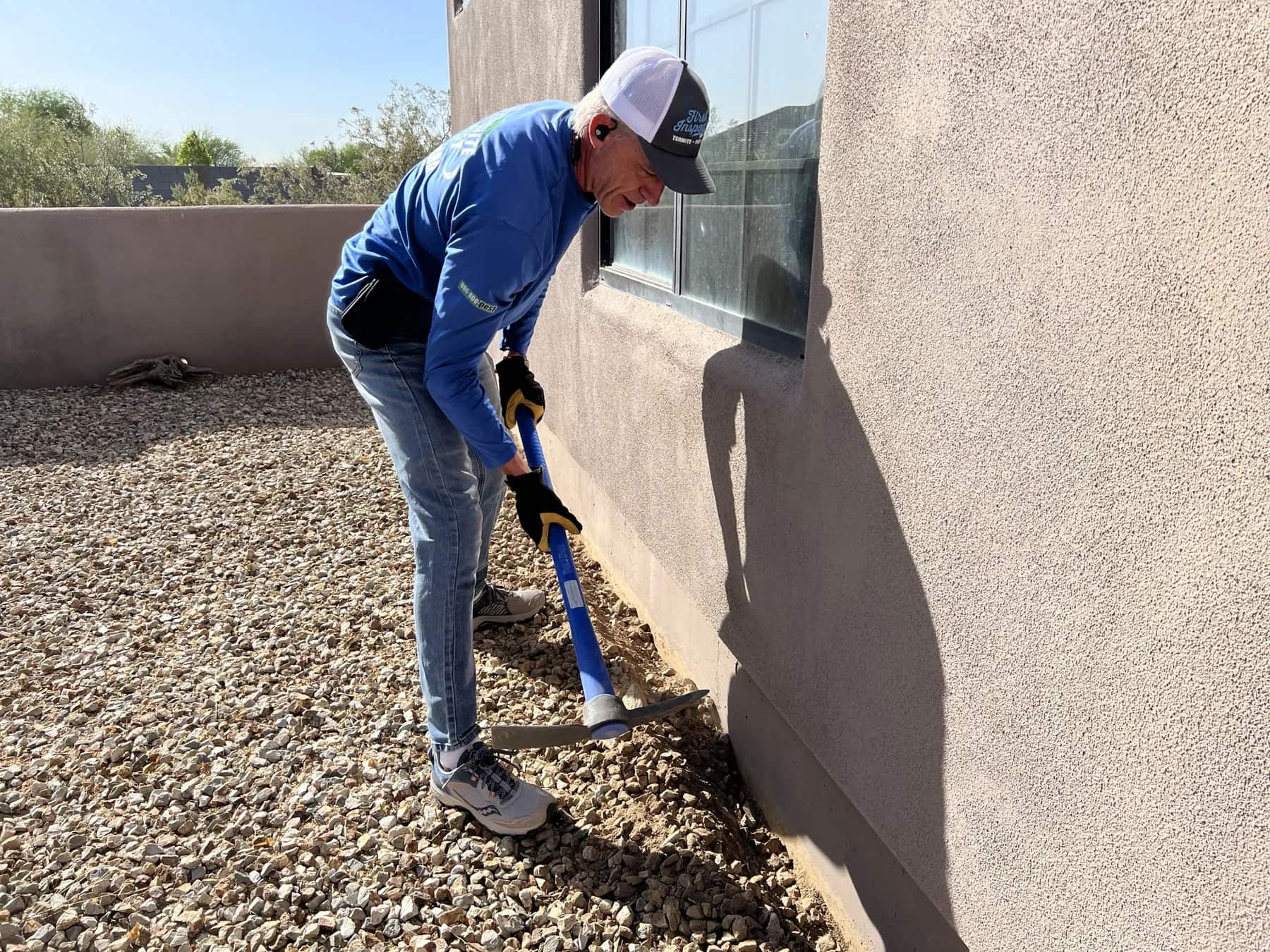
Block-wall voids
Hollow CMU cells run the whole perimeter of most Valley lots — cool, dark and undisturbed. Treating the wall face without dusting the cells leaves the population where it lives.
Landscape rock
Decomposed granite and rip-rap hold daytime shade and night-time warmth, and give scorpions and crickets continuous cover from the wall to the house.
Irrigation and valve boxes
The most reliable water on the property. Valve boxes in particular are a standing invitation — enclosed, damp and rarely opened.
The weep screed
The gap where stucco stops above the foundation. It is meant to drain, which means it is also an opening — and it runs the entire footprint of the house.
Door thresholds and garage corners
An adult bark scorpion gets through a gap about the thickness of a credit card. That is most unsealed door sweeps and most garage-door bottom corners.
Grade and vegetation contact
Soil or rock built up against the stucco, and shrubs touching the wall, both bridge the perimeter — pests walk over the treated band instead of through it.
Phoenix pest pressure
When the Valley actually starts calling
Scorpion demand starts climbing in March and does not peak until August. By the time most people call, the population has had five months to build.
| Pest | January | February | March | April | May | June | July | August | September | October | November | December |
|---|---|---|---|---|---|---|---|---|---|---|---|---|
| Scorpionspeaks Aug | January: 170 searches per month | February: 170 searches per month | March: 320 searches per month | April: 260 searches per month | May: 390 searches per month | June: 480 searches per month | July: 480 searches per month | August: 720 searches per month | September: 720 searches per month | October: 590 searches per month | November: 260 searches per month | December: 170 searches per month |
| Termitespeaks Sep | January: 260 searches per month | February: 110 searches per month | March: 90 searches per month | April: 70 searches per month | May: 70 searches per month | June: 50 searches per month | July: 50 searches per month | August: 260 searches per month | September: 390 searches per month | October: 260 searches per month | November: 70 searches per month | December: 110 searches per month |
| Mosquitoespeaks Oct | January: 10 searches per month | February: 10 searches per month | March: 20 searches per month | April: 30 searches per month | May: 40 searches per month | June: 30 searches per month | July: 20 searches per month | August: 30 searches per month | September: 70 searches per month | October: 260 searches per month | November: 210 searches per month | December: 10 searches per month |
| Rodentspeaks Sep | January: 140 searches per month | February: 90 searches per month | March: 110 searches per month | April: 90 searches per month | May: 70 searches per month | June: 70 searches per month | July: 90 searches per month | August: 140 searches per month | September: 210 searches per month | October: 210 searches per month | November: 70 searches per month | December: 70 searches per month |
| Bees & waspspeaks Feb | January: 320 searches per month | February: 590 searches per month | March: 590 searches per month | April: 480 searches per month | May: 260 searches per month | June: 390 searches per month | July: 320 searches per month | August: 260 searches per month | September: 390 searches per month | October: 390 searches per month | November: 110 searches per month | December: 140 searches per month |
| Antspeaks Apr | January: 20 searches per month | February: 0 searches per month | March: 10 searches per month | April: 40 searches per month | May: 10 searches per month | June: 10 searches per month | July: 10 searches per month | August: 20 searches per month | September: 30 searches per month | October: 10 searches per month | November: 10 searches per month | December: 0 searches per month |
| Roachespeaks Apr | January: 10 searches per month | February: 10 searches per month | March: 20 searches per month | April: 50 searches per month | May: 10 searches per month | June: 10 searches per month | July: 10 searches per month | August: 30 searches per month | September: 10 searches per month | October: 10 searches per month | November: 10 searches per month | December: 10 searches per month |
Scorpions
The steepest curve of any Valley pest — searches run roughly four times higher in late summer than in midwinter, and the climb starts in spring rather than at the peak.
Termites
A sharp August–September spike that lines up with post-monsoon swarming, plus a smaller January bump that tracks the winter real-estate and inspection cycle rather than insect activity.
How to read this: each row is scaled against its own busiest month, so it shows when demand for that pest peaks — not how one pest compares to another. This measures when people search, which is a proxy for pest pressure rather than a measurement of it. Source: Google Ads keyword planner via DataForSEO, Phoenix metro, rolling 12 months to July 2026, retrieved 2026-08-19.
What happens next
What the first visit actually looks like
Five steps. The price comes fourth — after you know what we found, not before.
- Step 1
You tell us what you have seen
Call or send the form. What you noticed and where is genuinely the most useful thing you can give us — it tells the technician where to start looking.
- Step 2
We walk the property
The inspection is free. The technician works the block wall, the yard, the perimeter and the entry points, looking for harborage, moisture and the routes in — not just the pest you called about.
- Step 3
You hear what we found
Before any price. What is driving the problem, where it is coming from, and what the property actually needs — including anything worth sealing that is not our work to do.
- Step 4
You get a price, then decide
Quoted from published starting rates against what the property needs. Estimates can be given online or over the phone. In the owners’ words on their Google profile: “No pushy sales.”
- Step 5
We treat the four zones
The initial visit resets active pressure across all four barriers. Recurring visits maintain the outer three; the interior typically needs treating only semi-annually or annually after that.
Plans & Pricing
Simple plans. Clear starting prices.
See your options before you call. Every service starts with a free inspection and quote—and every service is guaranteed for 30 days.
Monthly
Every month
from$59
Most homes under 2,500 sq ft
Heaviest pressure — bad scorpion or chronic pest problem you want gone.
30-day service guarantee included.
Get a monthly quote- Flagship Special
Bi-monthly
Every 2 months
Retail
$79special$69
Most homes under 2,500 sq ft
Most common service frequency. Guaranteed for 30 days.
30-day service guarantee included.
Get the $69 special Quarterly
Every 3 months
from$99
Most homes under 2,500 sq ft
Only recommended for low pest pressure or minimal maintenance requirements. Guaranteed for 30 days.
30-day service guarantee included.
Get a quarterly quote
What's included
Pests covered by general service
Everything below is handled on a standard plan except termites, bird exclusion and weeds, which are separate services with their own pricing.
Scorpions
Scorpion control in Arizona works by treating where scorpions live and hunt — block-wall voids, landscape rock, irrigation boxes and the stem wall of the house — not just by spraying indoors.
How we treat itBees & Wasps
Bees and wasps in Arizona homes usually nest in wall and block voids where stucco has cracked, in irrigation boxes, under sheds, and in eaves near the roofline..
How we treat itTermites
Arizona’s subterranean termites travel from soil into a home through cracks, joints, plumbing penetrations and hidden soil-to-wood contact.
How we treat itRodents
The noise is almost never where the way in is.
How we treat it
Where we work
Across the Phoenix metro
31 Valley cities. We come to you — there is no shop to visit, and no branch offices to pretend about.
Pest pressure is not the same across the Valley. Homes backing onto preserve and wash corridors carry the heaviest scorpion load; new subdivisions inherit whatever the desert or farmland they replaced was already supporting; older flood-irrigated streets hold the moisture roaches and crickets need.
Straight answers
What people actually ask
Taken verbatim from what Phoenix homeowners search — including the two questions this category usually avoids.
It is in the right range for a straightforward home. Our own recurring service starts at $59 a month, the Bi-monthly Flagship Special is $69 (retail $79), and quarterly service starts at $99 — those are the current starting prices confirmed by the owner, and they apply to most homes under 2,500 sq ft. What moves the number is lot size rather than house size, because three of the four zones we treat are outside. A big yard costs more to treat than a small one even when the houses match.
It is when you are paying for someone to spray a perimeter and leave. The test is whether anyone can tell you why the pest is there. If the technician cannot point at the moisture source, the harborage or the entry point, you are buying a visit rather than a result. Ask any company — including us — what they found and why they are treating where they are treating. The answer tells you what you are buying.
Scorpions, ants, roaches, spiders, crickets, earwigs and the other common Valley pests, treated across all four zones of the 4D Barrier — the block wall, the yard, the home perimeter and the interior. Termites, bird exclusion and weed control are separate services with their own pricing, because they are different work.
It depends on what was applied and where, so your technician gives you the specific answer before they start. The general rule is that pets and children stay off treated surfaces until they are dry. Products are applied according to their label directions, and the label is what governs re-entry — not a marketing line. If anyone tells you a pesticide application is simply "safe", ask them which product and what the label says.
Because treatment disturbs harborage. Dusting a block-wall void or treating a valve box pushes what is living in there out into the open, so for a few days you can see more activity, not less — particularly with roaches and crickets. It usually settles within a week or two. If it has not, call us. Every service comes with a 30-day service guarantee.
Quarterly suits most Valley homes for preventive cover. Monthly or every-two-months makes sense where pressure is heavier — a lot backing onto open desert or a wash, heavy block-wall and rock landscaping, or an active problem you are still clearing. Pressure is not constant through the year either: searches for scorpion help in the Phoenix metro run about four times higher in late summer than in midwinter.
For most homes, after the initial visit, the exterior does the work. That is the whole logic of treating four zones: when the block wall, the yard and the home perimeter are maintained, the interior typically needs treating only semi-annually or annually. If you are seeing activity indoors, that is a signal something outside is not holding — which is where we look first.
Every service. Guaranteed for 30 days. It is included automatically, not reserved for one plan or price tier. Your written quote identifies the service-specific scope; the promise does not advertise a money-back or pest-free result that the written terms do not state.
Not usually for an exterior visit. Interior work needs access, so we agree a time window and the technician confirms before arriving. Service is by appointment during Mon–Fri 8am–5pm.
For a single ant trail on a patio, often yes. Where store-bought products struggle is anything with a source you cannot see: a colony under a slab, a scorpion population living in block-wall voids, roaches arriving through a sewer line, or rodents that need the entry point closed rather than the individual caught. A retail spray treats the thing in front of you. The question is whether the thing in front of you is the problem or the symptom.
Find out what’s getting in — and where
Tell us what you’re seeing. We’ll walk the property, explain what is driving the problem, and give you a price before any work begins.
Free inspection · Free quote · Every service. Guaranteed for 30 days.