
Skip to content
4.8 from 95 reviews
First Inspection Termite & Pest
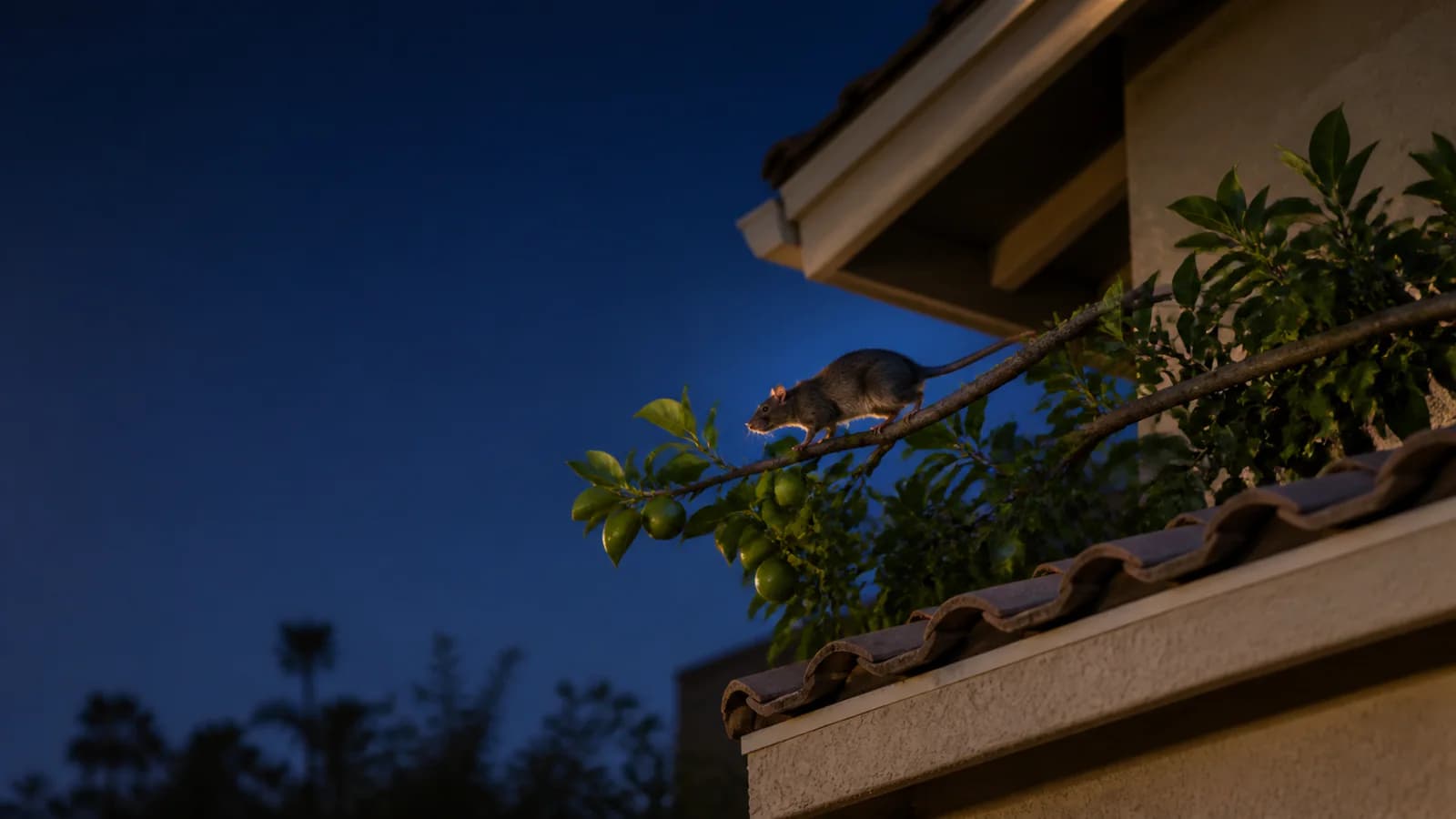
Roof rat approaching the roofline of a Phoenix stucco home from a citrus branch

Phoenix-Metro Rodent Control

Find the route.
Then deal with the rodents.

Roof rats are climbers. They reach a roof by a branch, a fence line or a utility wire, then work the edge for a gap — which is why the scratching you hear overhead is almost never above the place they actually got in.

  • 4.8 from 95 Google reviews
  • Free inspection and quote
  • Mon–Fri 8am–5pm

Free rodent inspection

Tell us what you are hearing and where. We will come and find the route.

By giving us your number you agree we may call or text you about this request. Message and data rates may apply. Reply STOP to opt out.

Add a ZIP or a note (optional)

Free inspection and free quote · By appointment · 30-day service guarantee included · We never sell your details

Straight answer

Why the noise and the way in are different places

The noise is almost never where the way in is. Roof rats climb — they get onto a roof from an overhanging branch, a fence line or a utility wire, enter at a roof return, a vent or a wall penetration, then travel inside the structure to wherever is warm and quiet. Following the sound finds the animal. Finding the route means walking the building.

That is the whole reason this starts with an inspection rather than a price list. Removing what is inside and closing the way it got in are two separate pieces of work, and which ones a property actually needs is decided by looking at it — not by assuming.

What that means in practice: a technician walks the property and the roofline, you get told what was found and where, and the scope and the price come after that. The inspection is free.

How they get in

Five routes onto a Phoenix roof

Four of these five are above head height. That is the part people are surprised by, and it is why an inspection that only walks the foundation misses the answer.

Common rodent travel and entry routes — simplified illustration. Construction varies house to house; this is not a drawing of any specific property.

Tree canopy to the roofLands on the roof, enters at the roof return or eave

A branch that touches or overhangs the roofline is a bridge. Rodents that climb do not need it to be a thick branch, and they do not need it to touch the roof tile — close is enough. Once they are on the roof they are walking the edge looking for a gap, and the roof return, where a short stub of roof meets a wall, is one of the most reliable ones on a Valley house.

Why it happens here: Citrus, olive, palm and mature ficus all sit at roof height across the older Phoenix suburbs, and fruit on the tree is a reason to keep coming back.

Utility line to the eaveFollows the line in, enters at a vent or the fascia

A service line running from a pole to the house is a route with no gaps in it. It arrives exactly where the roof meets the wall — the eave, the fascia, the gable vent — which is the part of the building envelope with the most joints and the fewest people looking at it.

Why it happens here: Overhead service is still common on the Valley housing stock built before the 1990s, and it lands at the eave by design.

Block wall to the structureWalks the wall, transfers where it meets the stucco

A property wall that runs up to the house is a covered highway at height, and the point where it meets the wall of the building is a joint between two different materials that were built by two different trades. That junction is worth looking at closely.

Why it happens here: Almost every Phoenix back yard is enclosed in CMU block, and the hollow cells inside that block are themselves a sheltered run.

Pipe and line-set penetrationsEnters the wall void, then travels inside the structure

Every place a pipe, conduit or refrigerant line passes through the exterior wall is a hole that was cut oversize and then sealed by whoever was on site that day. The seal is usually foam or mastic, both of which age badly in this climate. Behind it is a wall void that connects to the rest of the structure.

Why it happens here: Air-conditioning line sets, water heaters and irrigation valves put several of these on every Arizona house, generally on the least-visited side of the building.

Garage door cornersEnters the garage, then the wall void or the house

A garage door seals along its bottom edge, but the two bottom corners are where the seal, the jamb and the slab all meet, and that corner is rarely tight. The garage is then a warm, quiet, food-adjacent room that connects to the rest of the building.

Why it happens here: It is the one route on this list at ground level — which is why it is usually the only one a homeowner has already checked.

Select a route to isolate it in the drawing. With none selected, all five are shown.

This drawing shows what an inspection looks at. What work a specific property needs — and what it costs — is settled after someone has walked it.

Which animal is it

Roof rat, pack rat or mouse

These get mixed up constantly, and it changes where anyone bothers looking. The tail settles it faster than anything else.

Roof rat

Introduced

Rattus rattus

The tell: The tail is longer than its head and body put together, and it is hairless and scaly.

Tail
Hairless, scaly, longer than head and body combined
Ears
Large, almost hairless
Snout
Narrow and pointed
Droppings
Pointed, banana-shaped, ¼–½ inch

Above ground. Attics, soffits, overhead garage storage, vine cover on fences and walls, and the crowns of palms where old fronds have not been removed. University of Arizona puts their usual range at about 120 yards from the nest, so a roof rat in your attic is living on your block.

This is the climber, and it is the reason the inspection looks up rather than down. It reaches a roof along a branch, a fence line, a vine or a utility wire, then works the roof edge for a gap. It is also the one that hollows out citrus on the tree and leaves the rind hanging.

Pack rat (woodrat)

Native

Neotoma albigula and related species

The tell: The tail is hairy rather than scaly, and it is no longer than its head and body.

Tail
Hairy, bicolored, lighter underneath, no longer than head and body
Ears
Large and hairy
Snout
Blunt
Droppings
Blunt-ended, ½–¾ inch

Mostly outdoors, at ground level. It builds a midden — a large heap of twigs, cactus joints, leaf litter and collected debris — against a wall, in a rock crevice, at the base of a plant or in the bank of a wash. The white-throated pack rat is the one most often met in Phoenix suburbs.

A pack rat is usually a yard, vehicle and outbuilding problem rather than a structural one, though it will move into an attic or wall opportunistically. It is native, which the roof rat is not. Getting the identification right changes where anyone bothers looking.

House mouse

Introduced

Mus musculus

The tell: Size — an adult is far smaller than either rat, and it fits through a gap about the width of a pencil.

Tail
About as long as the head and body
Ears
Large relative to the head
Snout
Pointed, small
Droppings
Small, dark, rice-grain sized, under ¼ inch

Indoors and close to food — wall voids, cabinet backs, pantries, garages and stored boxes. It does not need much space and it does not travel far.

The gap that stops a rat will not stop a mouse. That single difference is why the sealing threshold everyone works to is set by the mouse and not by the rat.

Identification characteristics from University of Arizona Cooperative Extension bulletins az1775 and az1280.

The measurement

Stop measuring against pocket change

Almost every page on the internet tells you a mouse fits through a hole the size of a dime. Some of them are official. They do not agree with each other, and every coin comparison is less protective than the measured figure.

A mouse has no collarbone, and its fur makes it look bigger than it is. The National Park Service puts the rule simply: if a mouse can get its head through an opening, the rest of it follows.

Mouse

¼ inch (6 mm) — about the width of a #2 pencil

Rat

½ inch (13 mm)

Do not measure against pocket change. Measure in inches, and treat anything a quarter of an inch or wider as worth attention — that is the threshold that accounts for both rats and mice, and it is the one CDC, the National Park Service and UC Statewide IPM all converge on.

Where the official sources disagree

  • CDC — current guidance, updated April 2024

    ¼ inch or 6 millimeters, "the width of a pencil"

    CDC used to publish the nickel-and-half-dollar comparison. It has retired it. The old wording still circulates on hundreds of pages, including municipal ones.

  • University of Arizona Cooperative Extension

    Its consumer page says roof rats fit through an opening "as small as a dime" (0.705 in) — while its own bulletin az1280 says seal at ½ inch

    The same institution gives two different figures. Neither matches the ¼-inch threshold used for sealing.

  • Maricopa County

    Roof rats enter "through any opening larger than a nickel" (0.835 in)

    The least protective figure found anywhere — a homeowner following it would leave ½-inch and ¾-inch openings alone.

What are you hearing?

What the sound usually means

None of this is a diagnosis — it is where an inspection would start looking. Two of these have more than one plausible cause.

  • Scratching or running overhead, after dark

    Consistent with roof rats. They start moving around dusk, and the ceiling below an attic is where people hear them first.

    Could also be: Birds nesting in a tile roof or eave — which is a different job, and daytime activity is the usual giveaway.

  • Scratching inside a wall

    Something is using the wall void as a run. Wall voids connect to the rest of the structure, which is why the entry point is often nowhere near the noise.

    Could also be: A rodent that got in at a pipe or line-set penetration on the far side of the house.

  • Gnawing, or a smell of hot wiring

    Rodent incisors grow continuously and get worn down on whatever is available, including cable insulation and irrigation line.

    Could also be: Worth treating as urgent regardless of species.

  • Citrus hollowed out on the tree, rind left hanging

    A roof rat signature. Extension describes them hollowing out fruit and, on sour citrus, eating the rind and leaving the fruit hanging.

    Could also be: Fruit on the ground being taken is less specific — several animals do that.

  • Droppings in the garage, pantry or a cupboard

    Shape and size narrow it down — pointed and ¼–½ inch suggests roof rat, blunt and ½–¾ inch suggests pack rat, rice-grain sized suggests mouse.

    Could also be: Droppings alone are not a reliable species ID. Do not sweep or vacuum them — see the cleanup steps.

  • Not sure — something is just off

    Rub marks along fence tops, beams and pipe runs are one of the more reliable signs, because rodents follow the same route repeatedly and leave grease behind.

    Could also be: This is what an inspection is for.

Droppings

Do not sweep it and do not vacuum it

This is the single most common mistake, and a HEPA vacuum does not make it safe. The procedure below is CDC's, with Maricopa County's local contact time.

  1. Open it up and walk away for half an hour

    Open doors and windows and leave the space for 30 minutes before you start. CDC puts ventilation first for a reason — the risk is airborne, not on your hands.

  2. Do not sweep it and do not vacuum it

    This is the one that catches people out, and a shop vacuum or a HEPA vacuum does not make it safe. Arizona DHS states the likelihood of transmission is increased by the use of brooms or vacuum cleaners, because both put dried urine and droppings into the air you are standing in.

  3. Wet everything first

    Rubber or plastic gloves on. Spray droppings, urine, nesting material and any carcass with a labeled disinfectant, or with one part household bleach to nine parts water mixed fresh. Soak it until it is genuinely wet. Maricopa County specifies at least 15 minutes of contact time before you touch anything; CDC says 5 minutes or whatever the product label states.

  4. Wipe, bag, bag again

    Pick it up with paper towels. Put the towels and any used traps into a plastic bag, tie it, put that bag inside a second bag, tie that, and put it in a covered bin that gets emptied. Then mop and disinfect the hard surfaces around it.

  5. Wash your hands twice

    Wash your gloved hands with soap and water before you take the gloves off, then wash your hands again once they are off.

  6. Know where the line is

    Fabrics go through a hot wash; rugs and upholstery get shampooed. Heavy contamination calls for more protection than gloves, and CDC directs rodent-contaminated ductwork to a professional rather than a homeowner.

What happens

What a rodent visit actually involves

Set out plainly, including where the boundaries are.

The stated approach

First Inspection describes its rodent work as combining trapping, exclusion and changes to the conditions around the property. Technicians also apply rodent bait during service — that one is confirmed by a customer rather than by us.

Which of those a property needs, and in what order, comes out of the inspection. Every home is built differently and the activity is never in the same place twice.

Company is always attentive on scheduling. Technician are always on time and do a good job; they are also cognizant of applying insect spray and rodent bait.
Geronimo Romero · Google review, 2025-04-04

What we are not telling you we do

Plenty of companies advertise attic clean-outs, insulation replacement, decontamination, one-way doors and a rodent-free warranty. We are not claiming any of those here, because we are not going to describe work we have not confirmed we perform.

If your situation needs something outside what we do, we would rather say so at the inspection than after you have paid for a visit.

Every First Inspection service, including rodent control, comes with the 30-day service guarantee. That is a guarantee on the service provided, not an invented promise that every property will remain rodent-free regardless of entry conditions.

Nine years, three homes

We’ve used first inspection termite and pest for more than 9 years accross three different homes in the surprise and litchfield park area. Each home had scorpion, rodents, spiders or ant problems prior to us moving in. First inspection has always scheduled us quickly, shown up on time, are always professional and knowledgeable and takes care of our pest problems.

Jessica Thrailkill · Google review, 2024-06-17 · Surprise and Litchfield Park

Where we work

Rodent control across the Phoenix metro

Questions

What people ask about rodents

Built from what Phoenix homeowners actually search, not from a generic pest-control list.

About a quarter of an inch — six millimeters, roughly the width of a #2 pencil. A rat needs about half an inch. Mice have no collarbone, so if the head fits, the body follows. You will see the gap described as "the size of a dime" all over the internet; a dime is nearly three times wider than the figure CDC actually publishes, and CDC retired the coin comparison in 2024. Work in inches, and treat anything a quarter inch or wider as worth attention.

The tail settles it. A roof rat has a hairless, scaly tail that is longer than its head and body combined; a pack rat has a hairy tail no longer than its head and body. Roof rats are introduced, live above ground and get into attics. Pack rats are native, build large debris middens at ground level, and are usually a yard or outbuilding problem rather than a structural one.

Because the noise and the way in are almost never the same spot. Roof rats climb — they reach the roof by a branch, a fence line or a utility wire, get in at a roof return, a vent or a wall penetration, and then travel inside the structure to wherever it is warm and quiet. Following the sound finds the animal. Finding the route takes walking the building.

No — and a HEPA or shop vacuum does not change that. Arizona DHS states that using brooms or vacuum cleaners increases the likelihood of transmission, because both put dried droppings and urine into the air. Ventilate the space for 30 minutes first, wear gloves, wet everything thoroughly with one part bleach to nine parts water, leave it at least 15 minutes per Maricopa County, then wipe up with paper towels and double-bag the waste.

No. University of Arizona Cooperative Extension states that roof rats have never been implicated in a human hantavirus incidence and are not considered a hantavirus reservoir species. The Arizona reservoir for Sin Nombre virus is the deer mouse, and Maricopa County reports that roof rats tested locally for hantavirus, plague and tularemia have all come back negative to date. Handle droppings carefully anyway — but a roof rat is not a hantavirus exposure.

No. That is a common belief and it is not how it works — a rodent that takes bait does not go outside to die, and nothing about bait closes the opening it came in through. It is one tool among several, which is why what gets used is decided after someone has looked at the property rather than before.

There is no good evidence that ultrasonic devices clear an established rodent problem. Strong scents may briefly discourage an animal, but they do not close a gap, and a rodent with an established route and a food source generally puts up with them.

No — and nobody should tell you to. Fruit and an overhanging canopy make a property more attractive and give a climber a way onto the roof, so picking up fallen fruit and keeping branches off the roofline both genuinely help. Removing the tree is not the recommendation, and roof rats travel from surrounding properties regardless.

They are active all year here, but University of Arizona Extension notes they are far more active — and far more often reported — from November through May, when backyard citrus is carrying fruit. Search demand across the Valley tells the same story from a different angle, peaking sharply in September and October as night temperatures start to drop.

It depends on what the inspection finds — what is active, how it is getting in, and what the construction allows. The inspection itself is free, and you get the price before any work is scheduled.

Hearing something overhead?

Tell us what you are hearing and where. We will come out, walk the property and the roofline, and show you the route before anyone talks about price.

Free inspection · Free quote · Mon–Fri 8am–5pm