
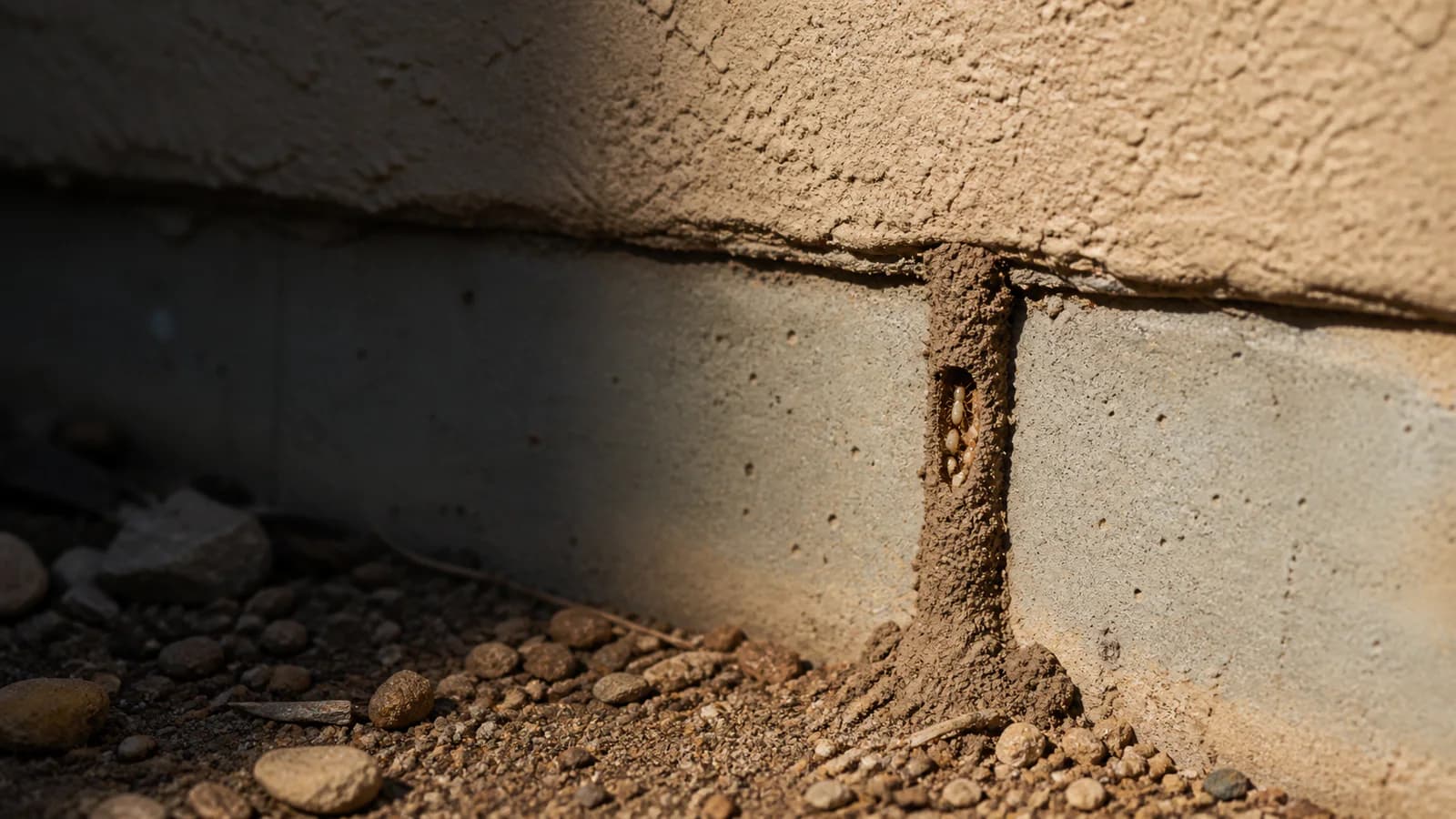
Phoenix metro · desert subterranean termites
Termite control & treatment in Phoenix
Desert subterranean termites live in the soil and reach your framing through mud tubes. Termite work starts with an inspection to find those entry points and determine where treatment needs to be focused.
- 4.8 from 95 reviewsOn Google
- Free treatment estimateIn writing, before work starts
- Arizona-licensedCertified applicator work
- 30-day service guaranteeIncluded with termite service
Free termite estimate
Tell us what you found and where. We will inspect before quoting anything.
You have seen something
Tubes, swarmers or damaged wood
A technician inspects the structure and prepares a free written treatment estimate. This is not the official report used in a real-estate transaction.
Request a free estimateYou are buying, selling or refinancing
You may need the official report
A lender, loan program or purchase contract may require the Arizona Wood-Destroying Insect Inspection Report — a regulated three-page report on the state’s approved form. It is a separate service with its own fee, from $65.
Termite inspections & the WDIIRThese are not the same thing. A free termite treatment estimate is not a WDIIR, and a WDIIR is not simply a treatment quote. If a lender, loan program or purchase contract calls for the official report, order the WDIIR. If termites are found, a separate treatment proposal will be included with the report.
Arizona construction
How subterranean termites reach a Phoenix home
The colony is in the soil and the wood is above concrete, so they have to bridge the gap. Where they bridge it decides what treatment has to reach.
In the Phoenix low desert almost all structural termite work involves the desert subterranean termite, Heterotermes aureus. University of Arizona Cooperative Extension identifies it as Arizona’s number one economic urban pest and the most common subterranean termite in the Sonoran Desert below 4,000 feet — Phoenix sits around 1,100. It tolerates heat and drought, and unlike species that seek damp or decaying wood, it readily attacks dry, sound structural lumber.
Common subterranean-termite pathways, simplified. Construction varies, and no single drawing covers every house.
Mud tubes shelter subterranean termites from dry, exposed air and predators such as ants. They are among the most common and visible signs of termite activity at a Phoenix-area home.
Evidence your defenses were breached
What you found, and what it tells us
Every one of these signs is worth a closer look. No single sign tells you whether termites are active today, how far any damage extends, or which treatment your home needs; the inspection puts the evidence in context.
Mud tubes on the stem wall
Pencil-width tunnels of soil, fecal material and chewed wood running up a foundation, stem wall, pier or garage wall.
- Proves
- That termites have been active at that spot and found a route from the soil toward the structure. Where a prior soil treatment was installed, the route may also indicate that protection at that location needs to be evaluated.
- Doesn’t prove
- How recently the tube was used, how far the activity extends, or whether structural damage is present. An inspection puts the tube in context and determines the next step.
Don’t break the tube open to “check”. It destroys the evidence an inspector uses to judge how established the activity is, and it tells you very little on its own.
Winged swarmers, usually after a monsoon rain
Small dark winged insects flying at dusk, often in numbers, typically July through September after a substantial rain.
- Proves
- A mature colony nearby is reproducing. Desert subterranean termites swarm in mass on the evening after a summer storm.
- Doesn’t prove
- That the colony is in your structure yet. Swarmers fly in from neighboring lots and open desert, and what they are doing over your property is looking for a way in. Finding them is the right moment to have the barrier checked.
Don’t assume it is termites. Winged ants swarm too, and the difference matters — see the comparison below.
Discarded wings on a sill or in a web
Small equal-length wings shed in piles near windows, doors and light fixtures after a swarm.
- Proves
- Swarmers were present and have landed. Termite swarmers drop all four wings once they have found a site.
- Doesn’t prove
- Where they came from, or that they have successfully started a colony in your structure.
Don’t sweep them all up before an inspection. The wings are identifiable — they help establish what you actually had.
Damaged or hollow-sounding wood
Timber that sounds hollow when tapped, blistered paint, or a surface that gives under light pressure. Desert subterranean termites attack dry, sound lumber, not just wet or rotting wood.
- Proves
- Wood has been consumed, which means termites were active there long enough to leave visible or audible damage.
- Doesn’t prove
- How far the damage extends or whether structural repairs are necessary. Only the exposed portion can be evaluated during a pest inspection.
Don’t start opening walls to find out. Have it inspected first — what is exposed changes what can be treated and how.
Activity found during a remodel
Galleries packed with soil, live insects, or old damage exposed when a wall, floor or cabinet run comes out.
- Proves
- Termites reached that structural element at some point, whether the exposed evidence is old or current.
- Doesn’t prove
- Whether it is current. Exposed old damage is common and does not automatically mean an active colony.
Don’t cover the area again before it has been inspected. When concrete or framing is exposed, the treatment proposal can address the accessible area and may avoid drilling through new flooring or cabinets later.
The part that matters
Whether the activity is live today is what the inspection determines. A mud tube or damage can show that termites reached a specific part of the structure; discarded wings only show that swarmers were present and landed, sometimes from a nearby colony. No single sign establishes how recent or widespread the activity is. That is why every sign here ends the same way: preserve the evidence and have it inspected so the proposal is based on the actual route, construction and activity.
Identification
Termite swarmer or flying ant?
Both swarm, and in Arizona both do it around the same time of year. Three features tell them apart.
| Feature | Termite swarmer | Winged ant |
|---|---|---|
| Waist | Broad and straight-sided. No visible narrowing where the abdomen meets the thorax. | Sharply pinched, with an obvious narrow waist. |
| Antennae | Straight and beaded, like a tiny string of beads. | Bent, with a distinct elbow. |
| Wings | Four wings, all roughly EQUAL in length, usually much longer than the body. | Also four wings — but the front pair is noticeably LARGER than the back pair. |
The wing count is where many pest-control companies get it wrong. Both insects have four wings — the difference is that a termite’s four are roughly equal in length, while an ant’s front pair is noticeably larger than the back pair.
How we work
The Termite Record
Everything found, proposed, done and re-checked — written down. On a purchase this size, the documentation is most of the value.
- Step 1
The inspection
A technician walks the structure and the soil line — stem wall, slab edges, patio pours, plumbing penetrations, garage, and attic access where it is reachable. Looking for tubes, damage, and the soil and moisture conditions that let them reach wood.
- Step 2
The findings
You are shown what was found and where, before anyone talks about price. If there is nothing, we tell you that too.
- Step 3
The written proposal
The proposed treatment, methods, warranty and price are put in writing before work begins. No pushy sales — their words, on their own Google profile.
- Step 4
The treatment
The approved work is carried out where the construction and evidence require it. The product and method follow the written proposal and label directions.
- Step 5
The warranty
Every termite treatment includes a warranty of at least one year. Customers who renew receive an annual inspection. If termite signs appear during an active warranty, call us; we will inspect and retreat the covered area at no additional charge, subject to the written warranty terms.
This is not our 4D Barrier. The 4D Barrier is our recurring general-pest program — scorpions, ants, spiders, roaches and other surface pests. Termite work is inspected, quoted and carried out separately, because subterranean termites are reached through the soil and not through a perimeter spray.
What treatment involves
Why termite work targets the soil
Subterranean termites live and forage through soil and depend on moisture. That is the pressure point. Termite work targets the soil and the specific routes into your structure, not only the insects visible on the surface, which is why a general perimeter spray is not termite protection.
What that looks like depends on how your home is built — floating slab, post-tension slab, stem wall, block, patio pours and plumbing penetrations — and on where the evidence is. Some situations call for soil treatment. Interior evidence may also call for foam or dust in an accessible wall void or mud tube. Some homes need a combination. Your technician explains the findings and puts the proposed product, methods, warranty and price in writing before work begins.
If you want to know exactly what product would be used on your home, ask us when we quote. We will tell you the product name and apply it according to its label directions. You should expect any company to answer that question before you approve the work.
“Do you have to drill my concrete?”
Often — but only where the structure and evidence make it necessary. First Inspection does not drill post-tension slabs. Where termites are reaching wood through or beneath conventional concrete, the proposed treatment may need access to the soil below it. The inspection determines whether drilling applies to your home.
- Trenching
- A narrow trench in the soil next to the foundation lets the selected termiticide reach areas where termites can enter. The product, application rate and treatment area follow the label and written proposal.
- Rodding
- A long injection rod places product deeper in the soil than a trench reaches, often alongside footings. The inspection determines whether rodding is needed.
- Drilling
- Small holes through conventional concrete provide access where treatment must reach the soil below. The holes are patched afterward and may remain visible.
- Dusting & foaming
- For accessible interior evidence where finished flooring limits soil access, a technician may apply foam through a small wall opening or dust into an accessible mud tube. The inspection and product label determine whether either method is appropriate.
Free treatment estimate
Tell us what you found
We inspect, show you what is there, and price the work in writing before it starts.
- The inspection for your treatment estimate is free
- No contract is required for service
- Estimates online or over the phone, by appointment
“We have had First Inspection for over 10 yrs. We first contacted them when we had termites in our guest bedroom. They treated the house, and we have never seen another termite. They do good work.”
“We also have their Termite service, if we find any possible signs they are out soon to inspect and retreat the area if it needs to be done.”
Follow the inspector
What gets looked at
And, just as importantly, what an inspection cannot see.
Any inspection is limited to accessible areas. Nothing behind drywall, under a slab or inside a wall void can be assessed without opening it up. A report describes what was visible on the day — it is not a guarantee that nothing is present elsewhere.
- 01
The exterior stem wall
The full perimeter at grade — where tubes are found more often than anywhere else, and where grade, moisture and wood contact are assessed.
- 02
The garage
Expansion joints, the slab edge, stored lumber and the base of any framed wall. Garages are commonly where activity is first visible indoors.
- 03
Penetrations and joints
Plumbing and utility entries, expansion and construction joints, and any point where the slab is broken — these are the routes that do not need a visible tube.
- 04
Accessible interior
Baseboards, cabinet bases, closet floors, and any accessible sub-floor area, looking for tubes, damage and moisture.
- 05
Conducive conditions
The five categories Arizona defines by rule, recorded whether or not there is active evidence.
Conditions, not proof
What makes a Phoenix home easier to reach
Arizona defines these five categories by rule for the official report. Having one is not evidence of termites — it is a condition that makes access easier or inspection harder.
Faulty grade level
Soil, landscape rock or a raised planter built up against the stucco so it covers the weep screed, hiding the very surface an inspector needs to read.
Earth-to-wood contact
Any structural wood touching soil — fence posts against a fascia, a patio post set in dirt, a trellis fixed to the wall. It removes the need for a tube entirely.
Excessive cellulose debris
Rakeable wood debris, buried form boards, stumps against the footing, or firewood and lumber stacked within six inches of the structure.
Excessive moisture
Irrigation running against the foundation, a leaking hose bib, a failed drip line, or an AC condensate line discharging at the stem wall.
Inaccessible sub-areas
Crawl or sub-floor space with less than 24 inches of clearance, which limits what any inspection can actually see and report.
Correcting these reduces how easily termites reach a structure. It does not prevent infestation, and no inspection or report is a warranty against wood-destroying insects.
Where we work
Termite work across the Phoenix metro
31 Valley cities. We come to you — there is no shop to visit.
Straight answers
Termite questions people actually ask
Including the two nobody in this industry likes answering: whether we drill, and whether there is a warranty.
It means termites have bridged the gap from the soil to your home at that spot. Whether they are active in it today is what an inspection determines, but the route itself is proven either way, and an abandoned tube can be re-used. Leave it intact and have it inspected: breaking it open destroys the evidence an inspector uses to judge how established the activity is.
Almost all structural termite work in the low desert involves the desert subterranean termite, Heterotermes aureus. University of Arizona Cooperative Extension calls it Arizona’s number one economic urban pest and the most common subterranean termite in the Sonoran Desert below 4,000 feet — Phoenix sits around 1,100. Unlike damp-wood-seeking species, it readily attacks dry, sound structural lumber. Drywood termites exist in Arizona but are not the usual Valley problem.
No — if anything the reverse. The desert subterranean termite is adapted to heat and drought; UA Extension notes it tolerates both high temperature and desiccation and thrives in the hottest, driest parts of the Sonoran Desert. Its range is limited by cold, not by heat. A Phoenix home is not protected by the climate.
Desert subterranean termites swarm mainly during the monsoon, roughly July through September, typically flying at dusk on the evening after a substantial rain. It is not the only pattern — arid-land subterranean termites in the Valley tend to fly between January and March, and drywood termites are not rain-timed at all.
Three things. The waist: a termite is broad and straight-sided where the abdomen meets the thorax, an ant is sharply pinched. The antennae: a termite’s are straight and beaded, an ant’s are bent with an elbow. The wings: both have four — the difference is that a termite’s four are roughly equal in length, while an ant’s front pair is noticeably larger than the back pair.
An inspection to prepare a termite treatment estimate is free — the owners state on their Google profile that they will “inspect your home or business and provide a free termite treatment estimate.” That is separate from an official Arizona Wood-Destroying Insect Inspection Report (WDIIR), which a lender, loan program or purchase contract may require and which has its own fee.
Often, but not for every structure. First Inspection does not drill post-tension slabs. Where termites are reaching wood through or beneath conventional concrete, the proposed treatment may need access to the soil below it. The inspection determines whether drilling applies to your home. Any treatment holes are patched afterward and may remain visible.
It depends on what the inspection finds and how the house is built, which is why the recommendation follows the walk-through. Options can include liquid termiticide applied to soil, a bait system placed in soil, or targeted foam or dust for accessible interior evidence. University of Arizona Extension presents soil treatment and baiting as situational rather than one being universally better. Your written proposal identifies the product, method, scope and price before work begins.
Possibly, for a while — and with modern non-repellent products that is part of how they work rather than a sign of failure. Older termiticides repelled termites, so they simply avoided the treated soil. Non-repellents cannot be detected, so termites keep tunnelling through the treated zone, pick the product up and spread it to colony mates. UA Extension’s benchmark is that a good treatment should result in no visible termites by around three months. The Arizona Department of Agriculture answers “not necessarily” to whether a post-treatment sighting means the treatment failed.
Yes. Every termite treatment includes a warranty of at least one year. Customers who renew receive an annual inspection. If termite signs appear during an active warranty, call us; we will inspect and retreat the covered area at no additional charge, subject to the written warranty terms. Review the coverage and renewal terms in your proposal before work begins.
Termite treatment addresses the infestation, not the structure. Where damage needs repair, that is work for a qualified contractor, and if the damage looks structural it is worth having someone competent to assess it do so. A pest technician is not a structural engineer and should not be telling you a building is safe.
A Wood-Destroying Insect Inspection Report may only be completed by a Certified Applicator licensed in the wood-destroying organism management category, working under a licensed pest management business, on the Office of Pest Management’s approved three-page form — A.R.S. § 3-3633 and A.A.C. R3-8-307. It is not the same as a home inspection, and a general home inspector cannot issue one.
Sources for the entomology and regulation on this page
- Arizona Termites of Economic Importance (AZ1369) — University of Arizona Cooperative Extension. Used for: Species, habitat, behavior, swarming and treatment comparison.
- A.R.S. § 3-3633 and A.A.C. R3-8-307 — Arizona Department of Agriculture, Office of Pest Management. Used for: WDIIR authority, licensing categories and conducive-condition definitions.
Found something that looks like termites?
Let us inspect it before you guess at the treatment. We will show you what we found, explain what the structure needs, and price the work before any of it begins.
Need the report for a sale or refinance? Order an Arizona WDIIR